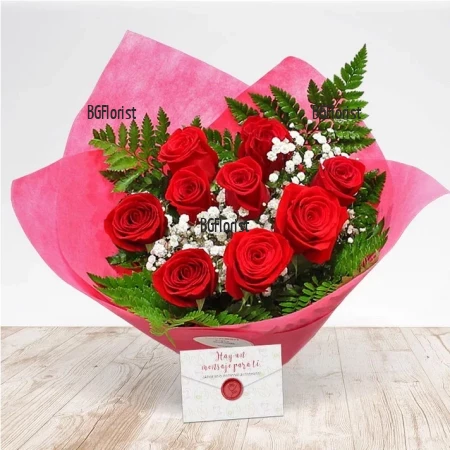
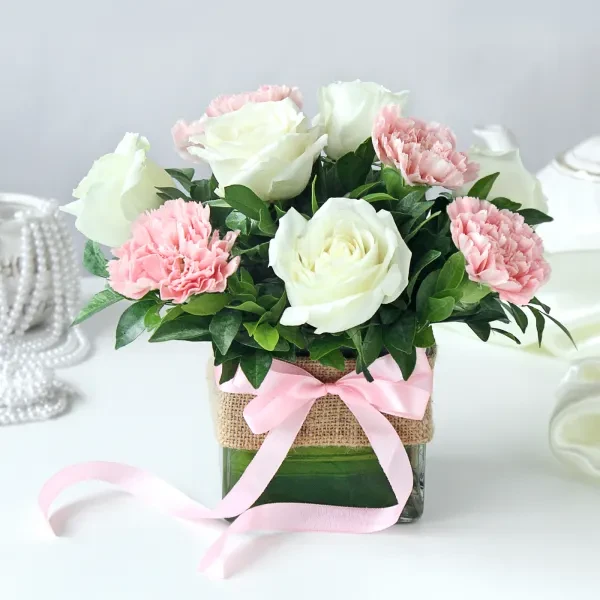
Round Bouquets
The small round bouquet is perfect for intimate and smaller wedding celebrations, especially when the bride opts for a short dress, a dress-suit, or a stylish pantsuit.
There are four main types of the classic round bouquet:
- Biedermeier
- Lace / Tulle
- Glamelia
- Round Tiered Bouquet
1. Biedermeier
This bouquet has a neat round shape, resembling a dome. It's known for its dense, closed structure because the flowers are placed very close together. The base of the bouquet is finished with a wreath of green leaves or an elegant tulle cuff.
It's usually arranged with flowers that have small round heads—mini roses, anemones, daisies, or mini carnations. The flowers are tightly arranged in concentric circles, spirals, or casually scattered elements. The cuff is made from evergreen viburnum or maidenhair fern. When creating this type of wedding bouquet, it's important for the stems to be of equal length. After securing and wrapping them at the base with damp cotton (to keep them fresh), they form the body of the bouquet.
2. Lace / Tulle
This bouquet also has a dome shape but visually resembles airy lace curls mixed with plant material. The arrangement includes one to three types of flowering plants—often combinations of roses, lilies, and gladioli, or gladioli, roses, and daisies.
For greenery, two types of leaves with different textures are chosen, like hosta and maidenhair fern. Flowers and leaves can be arranged individually, in groups, or mixed, with the overall silhouette shaped by circular floral ruffles. The lace or tulle elements are gathered into fluffy tufts, between which the flowers and decorative greenery gently peek out. Plants can be used with their natural stems or cleaned and reinforced with floral wire.
3. Glamelia
This unique bouquet originated in England as an original decoration for brides, with a name hinting at a blend of gladiolus and camellia. Its shape is round, flatter, and very dense, mimicking the structure of a large camellia flower. The finished look is achieved with an outer wreath of petals and asymmetrically placed decorative greenery.
The bouquet is handcrafted using individual gladiolus petals. They're arranged radially and symmetrically in concentric circles around the center, with the lowest dense ring formed by arrowroot or laurel leaves. The composition is often complemented by ferns (like Nephrolepis) or other delicate greenery. When using gladioli and rhododendrons, this type of arrangement is sometimes called a "floral tuft." During preparation, two or three petals overlap and are attached with thin silver wire, creating a new "stem" for the artificially crafted flower.
4. Round Tiered Bouquet
The concept here is clear from the name—the bouquet visually covers from 1/4 to 3/4 of the volume of a classic round dome. Its structure is more open and airy, allowing the inside of the arrangement to be seen. For better symmetry, lace cuffs are sometimes added.
The bouquet combines various shapes of flowers and leaves—daisies, heather, mini roses, tuberous begonias, and delphinium. The plants are freely placed at different levels (tiers) from the dense center to the periphery at equal distances. The design is broken up with the addition of decorative greenery, shaped like airy antennas or wings. Flowers can be used with their natural stems or wired and placed in a special bouquet holder.
Keep an eye on our blog for more interesting and curious articles about flowers and flower delivery.