
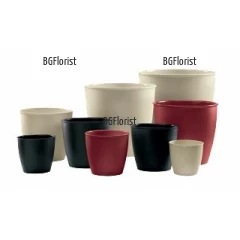
Containers for growing pot plants
"Plant containers" is a catch-all term. It covers all sorts of pots, vases, bowls, clay dishes, cups, baskets and anything else you can plant something in.
There are two main types. Growing pots have at least one hole in the bottom. Decorative pots have no holes, so you can put them on furniture without worrying about water leaking out.
The big downside of decorative pots is that they hold on to excess water. You need to drain them after every watering. Otherwise the roots can suffocate, which leads to fungus and then black rot. You'll know straight away when the plant's struggling: the leaves darken first, then dry out.
Growing pots can look good too, depending on how they're made. Some are fine clay, glazed, painted or have plaster details. If you're using one of these as a display pot, always stand it on a saucer. That way the water can drain out and the excess moisture has somewhere to go.
What size pot should you choose?
Most houseplants grow in fairly small pots, with their roots tightly packed into the soil. Plants with big palm-like leaves need a deep pot. Peperomia, Hypoestes, Saintpaulia, Fittonia and most small plants with lush foliage do well in wide, shallow pots.
As a rule of thumb, the pot should be 1/4 to 1/3 the height of the plant (roots and all) for plants under 1.5 m, and 1/5 for taller ones. In shops, pots are sold by diameter, which should be about 2/3 of the pot's height. For example, a pot 18–20 cm across can hold plants anywhere from 28 cm to 1.2 m tall. The bushier the plant, the bigger the pot it needs.
The pot should be big enough to keep the plant steady, but no more than 2–5 times its size.
Start young plants off in a small pot. When you repot, think about how the plant's height and roots compare to the size of the pot. The general rule: if the plant's growing well, go up 2–3 cm from the old pot. For fast growers or large pot plants, you can go up 4–5 cm.
What pots work for tall plants?
Tall plants are awkward to move around, so go for plastic pots. They're much lighter than clay. Don't plant them in decorative pots without drainage holes, though, as the excess water has nowhere to go.
Can you plant several different plants in one pot?
Yes, as long as they need the same light, temperature and watering. Cacti and succulents, for example, both like lots of light and not much water, so they're happy together. Leafy plants that like moderate light and regular watering also share a pot well: ferns, Chlorophytum, Syngonium and so on. Pick plants of a similar size so the bigger one doesn't crowd out its smaller neighbours. If you're squeezing a lot of plants into a small space, leave enough room between them so their leaves don't overlap and tangle. Otherwise they can wilt, and the leaves may start to die off. Give them plenty of air.